
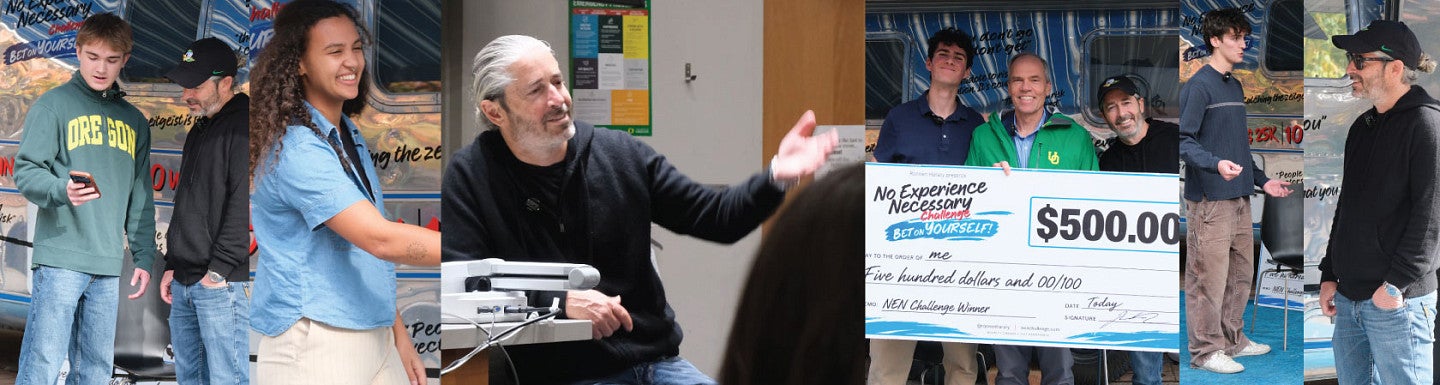
UO student founders successfully pitch Spin Master cofounder Ronnen Harary for seed grants.
Parked in front of the Lillis Business Complex directly beneath the giant Oregon "O," a mirror-polished 1976 Airstream named "Bessie" drew a crowd of curious students on Thursday, October 29.
The vintage trailer—which once made a trek to Burning Man before being rebuilt and buffed—wasn't on campus for a tailgate. Outside the Airstream stood Ronnen Harary, cofounder and former CEO of global children's entertainment powerhouse Spin Master, the company behind cultural phenomena like PAW Patrol, Bakugan, Hatchimals, and Kinetic Sand, and steward of iconic brands including the Rubik's Cube and Etch A Sketch.
The University of Oregon was one of only two West Coast stops on Harary's cross-country university tour celebrating his new book, No Experience Necessary: Why Betting on Yourself in Your Twenties Is the Best Decision You'll Ever Make. Hosted in partnership with the Lundquist Center for Entrepreneurship, the afternoon centered on the No Experience Necessary Challenge—a rapid-fire pitch competition.
The rules were simple: no slide decks, no résumés, and no prior business experience required. Capped at 25 slots, students had two minutes—60 seconds to pitch an idea and 60 seconds to field questions—for a chance to walk away with $500 from Harary on the spot. Students who received $500 seed checks then had seven days to put the capital to work, submit their receipts, and present a full pitch to compete for one of 10 $25,000 no-strings-attached grants.
At one point during the afternoon session, Edward Maletis Dean Bruce Blonigen even joined Harary, giving students the rare opportunity to pitch their ventures to both the dean and the billionaire founder side by side.
One of 12 UO students who received funding was Jack Ricketts, a business administration and Spanish major who previously earned Oregon Innovation Challenge funding, who pitched his sustainable apparel company, J-Rick Thrift. Ricketts rescues secondhand blank garments destined for landfills across the U.S., Mexico, and Pakistan, washing and screen-printing them with trendy designs for consumer resale on platforms like Depop and Poshmark, as well as supplying local businesses.
Harary was sold on the spot.
"He didn't ask a single question, so I think he really liked my idea," said Ricketts, who walked away with a $500 check. "With this funding, I'm buying an embroidery machine because my service-based business clients prefer embroidered polos over screen prints. It's going to help me sign on three new clients right away, including outfitting a student-run mobile oil changing startup and a local brewery."
Other Ducks tackled consumer wellness using artificial intelligence. First-year business finance student Sheldon Jensen pitched Doppel, an app that uses AI scanning to generate customized workout and nutrition plans modeled after their favorite superhero.
"What makes it unique is being able to train to look like a specific person or character instead of just a broad goal like ‘getting stronger,'" Jensen said. "Users track their weekly progress and share their streaks with friends."
Meanwhile, Maggie Byrne, a business and philosophy student who heads the UO Artificial Intelligence Student Association, flipped the traditional pitch format on its head. Rather than seeking the $500 check for her revenue-generating AI infrastructure startup, AM Collective, she spent her minute pitching Harary's team as a potential client.
"We're already revenue-generating, so instead of the $500, I pitched that I would like to meet somebody on his team," Byrne said. Harary agreed, opening the door for Byrne to explore deploying her startup's diagnostic software within his corporate network.
Following the afternoon pitch marathon, Harary held a "fireside" chat and Q&A with students, sharing how he launched Spin Master at age 23 alongside a college friend with zero industry experience, candidly discussing the self-doubt and friction that defined his early twenties. For Alexandra Gonzalez, a junior studying advertising with minors in AI and business, hearing a global CEO speak openly was a highlight.
"It's really great seeing someone like him—who has been the CEO of such a successful company—share the same inner thoughts that a college student has, feeling that same imposter syndrome or feeling like their ideas aren't being heard," Gonzalez said. "Giving students this opportunity—that's my biggest takeaway from this. One day, that can be us!"
Reflecting on his day in Eugene, Harary said the energy and collaborative spirit of UO students validated exactly why he decided to take "Bessie" out on the road.
"People really believed in their ideas—they wanted to bring them to life, and they pitched and advocated for them," Harary said. "As I write in my book, passion de-leverages risk, and you could really feel that passion today. When you're in your twenties, your energy is like an athlete's. Everybody is rooting for you, and there's a power in naivety that helps you push through what other people think is impossible."
Harary noted two qualities in particular that stood out among the student founders he met on campus: a natural instinct for partnership and a commitment to building businesses that serve a greater good.
"This generation has a lot of pepper," Harary said. "A lot of students came and pitched already with a partner in mind—even pitching in teams—already forming those relationships. And they want to contribute for altruistic reasons. It's not just about themselves; it's about, 'How do we make the world a better place?' I felt a lot of win-win sentiment today. Above all, this generation is 10 times more authentic and open than my generation ever was—and that is super welcoming."