
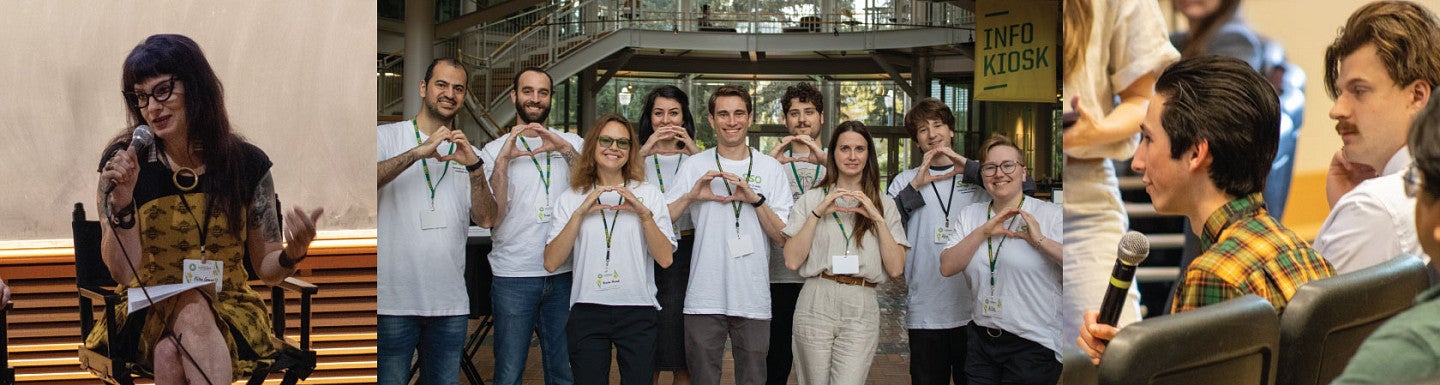
What do permaculture design, Amazon, a study abroad program, and Tillamook Creamery have in common? The Summit for Sustainable Organizations (SSO) found the shared thread April 10-11, 2026.
The annual conference is organized by graduate students at the University of Oregon's Lundquist College of Business—home to the #5 green MBA in the country—and is offered free to the public. This year's theme, Innovation to Impact, explored the many ways sustainability can be woven into business, across industries, roles, and career stages.
Twenty-five speakers brought decades of experience and a genuine desire to connect, creating an environment that united undergraduate students, graduate students, community members, and sustainability professionals at every level. A 10-person leadership team planned and executed the two-day event, co-led by first-year MBA student Kyle Meyer and Master of Science in Management student Allie Manning Lorino.
"It was a lot of communication between the two of us, figuring out how we wanted to keep everybody in the loop, which turned into a whole lot of group chats," said Lorino.
Planning began in October 2025, and for the leadership team, the process was as much a learning experience as the event itself—the kind of real-world, career-shaping opportunity that defines a Lundquist education.
"This was the first time I've been on a leadership team putting on a big event, not just staff or volunteer, but really able to form it," said Meyer. "A big thing I learned was having grace with myself and how it's okay that I don't know everything, because this is the first time I'm doing it. And encouraging that in others, too."
Lorino echoed the sentiment. "I learned so much about working together as a team, event planning, and how to make events as sustainable as possible on a tight budget. I have so many stories for job interviews."
John Davis, director of the Center for Sustainable Business Practices and a professor of practice, has been the faculty advisor for every SSO. His approach is to act as a "shadow advisor", attending meetings and offering input when needed, but not getting in the way of the students taking charge of designing and running the event.
"It's hard not to develop a deep appreciation for our students throughout the months of planning," Davis remarked. "Each year I am inspired by the depth of their talent, ingenuity, and professionalism."
The summit's lineup and programming was shaped by first-year MBA student Ian Evans and PhD student Sanam Haddadian. Evans, who served as programming and speaker outreach manager, had attended the previous year's event as a community member.
"I really enjoyed it, so I knew I wanted to be involved this year," he said. "I actually got the idea for the networking breaks from last year's event. I thought that worked really well, so I built it into the schedule."
Those intentional 20-minute breaks between sessions gave attendees space to connect with speakers at a deeper level. After Friday's sessions wrapped, more than 60 participants made their way to the Ninkasi Better Living Room for an after-hours mixer. The conversations that started earlier in the day kept going. "One part that really stood out for me was hearing three or four different people realize they were all based in Seattle and had never really connected," Meyer said. "Right there, they decided to meet up on a regular basis. That kind of thing is exactly what this event is for."
More than 100 people attended the two-day summit, with the 25 speakers volunteering their time. That scale, the leadership team found, was something of a sweet spot.
"Having 100 to 150 people attend feels like a really good number," Meyer explained. "You get to meet speakers in the morning, chat again over lunch, and see each other at the mixer. There's a real sense of community that builds over the two days."
Speakers came from across the sustainability landscape. Friday's lunch keynote featured Miranda Menard, MBA ’21, now senior program manager of energy and sustainability at CBRE.
"The summit adds a nice layer to the experiential learning that the Oregon MBA offers," says Miranda. "For me, that portion of the program was really powerful because we got to travel and see what the options are in the field and what people are actually doing."
Also returning to campus were Wyatt Cuddington, MBA ’23, and Anne Marie Duncan, MBA ’23, both of whom were involved in the inaugural SSO in 2023. Cuddington delivered a breakout session on his work with Amazon's Climate Pledge team, and Duncan joined a panel of WSP consultants moderated by Professor of Practice Josh Skov, academic director and industry mentor for the college's Center for Sustainable Business Practices. Their return reflects something central to the summit's mission: connecting the next generation of sustainability practitioners with UO alumni already doing the work.
"I feel like the summit has grown up," said Cuddington. "There's more infrastructure, and the content is updated for the times. But what's consistent is the spirit, bringing together people who are passionate about sustainability for honest conversations about the work. This is a unique aspect based on conferences I've been to."
Duncan appreciated the tone: "You can tell there's a lot of heart and care in everybody's work," she said. "Other sustainability conferences are still very much focused on the business case, the bottom line. This conference brings a different, more human aspect to it. Connection is the best part for me."
For the fourth straight year, the summit helped build Lundquist's growing network of sustainable business practitioners. From speakers and students to community members and the planning committee, everyone walked away with at least one practical tool or new connection to carry into their work.
"People were happy to give their time to an event put on by students, for the community" said Lorino. "And they stuck around for the whole time, too, which created a nice atmosphere with a lot of networking built in."
—Megan Jessup-Varnum, Lundquist College Communications